
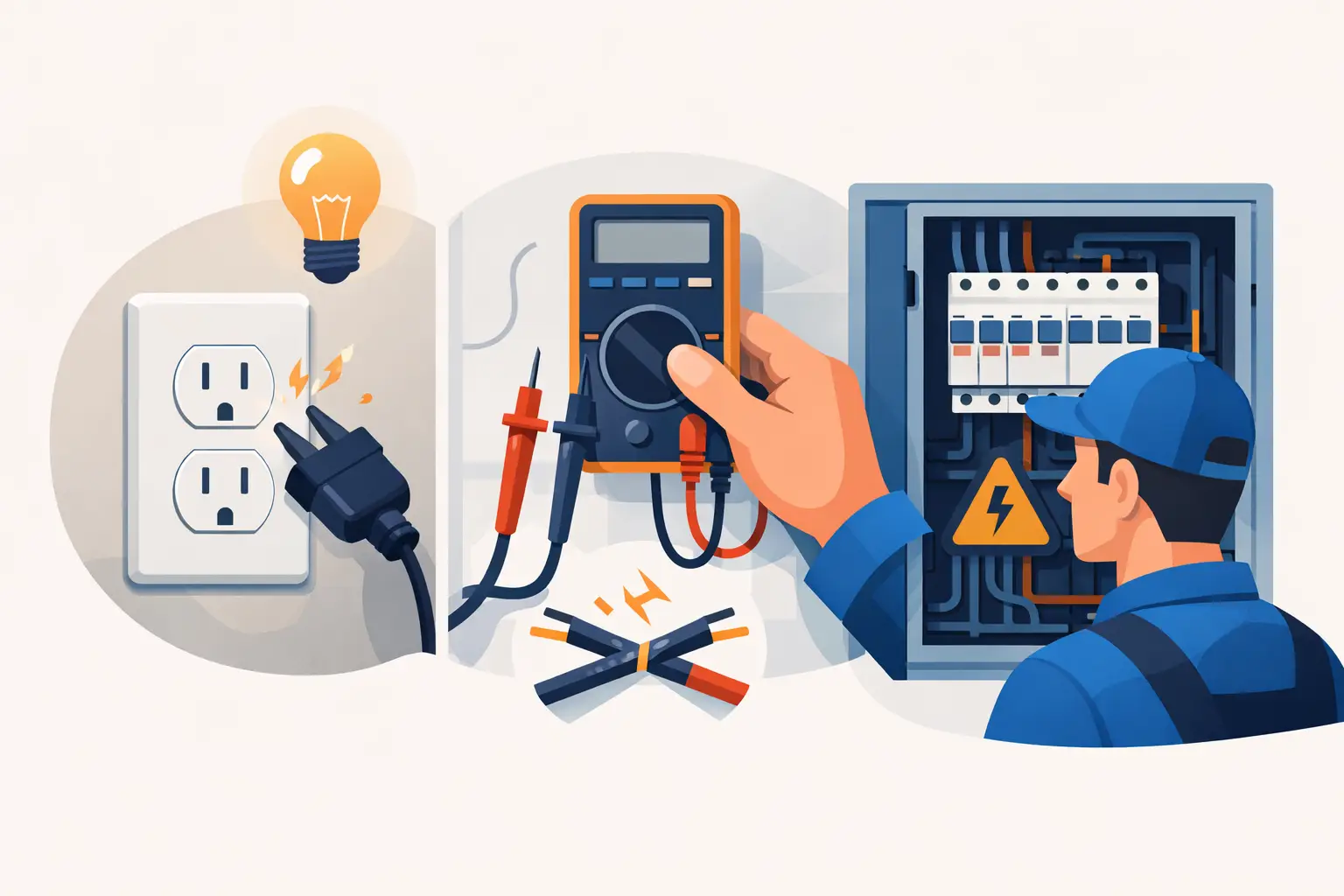
A dead outlet usually shows up at the worst time – when the coffee maker will not start, the charger stops working overnight, or a room suddenly loses power for no clear reason. Electrical troubleshooting for dead outlets starts with a calm, simple question: is this a minor reset, or a sign of a larger electrical problem in the home?
For homeowners, that distinction matters. Some outlet issues are straightforward, like a tripped GFCI or a breaker that needs attention. Others point to worn wiring, a failed receptacle, a loose connection, or a circuit problem that should be handled by a licensed electrician. Knowing what to check first can save time and help you avoid unnecessary risk.
Start with the simplest checks
Before assuming the outlet itself has failed, test the item you plugged in. A lamp, phone charger, or appliance can be the problem, not the receptacle. Try the device in a different outlet that you know is working.
If the device works elsewhere, plug something simple into the dead outlet, like a lamp or a small charger. This helps confirm that the problem is truly with the outlet or circuit. It is a small step, but it prevents a lot of guesswork.
Next, look for a wall switch that controls the outlet. In many homes, especially in bedrooms and living rooms, one half of an outlet may be switch-controlled. If a switch was bumped off, the outlet may seem dead when it is actually working as designed.
Check for a tripped breaker
One of the most common causes of a dead outlet is a tripped circuit breaker. Go to your electrical panel and look for a breaker that is out of line with the others or sitting between ON and OFF. If you find one, switch it fully OFF and then back ON.
If power returns and everything works normally, the issue may have been a temporary overload. That said, breakers do not trip for no reason. If it happens again, there is likely an underlying problem, such as too many devices on one circuit, a short, or a wiring issue.
If the breaker trips immediately after reset, stop there. Repeated tripping is a safety warning, not an inconvenience. That is the point where expert electrical repairs are the safer choice.
Look for a tripped GFCI outlet
A GFCI outlet is the type with TEST and RESET buttons, usually found in bathrooms, kitchens, garages, laundry areas, and outdoor locations. What surprises many homeowners is that one GFCI can protect multiple standard outlets downstream. That means a dead outlet in a bedroom, garage wall, or exterior area may actually be controlled by a GFCI somewhere else.
Press the RESET button on nearby GFCI outlets first. If you are not sure where they all are, check bathrooms, the kitchen backsplash, the garage, and exterior walls. In some homes, a garage or bathroom GFCI is the hidden reason another outlet loses power.
If the GFCI will not reset, there may be moisture, a ground fault, or a failed device. That is not a situation to force. A GFCI that refuses to reset is doing its job by warning you that something is wrong.
When one outlet is dead and others still work
This is where electrical troubleshooting for dead outlets gets more specific. If only one outlet is dead but the rest of the room still has power, the issue may be isolated to that receptacle or to a connection upstream on the same circuit.
Outlets can wear out over time, especially in busy parts of the home where plugs are inserted and removed often. A damaged receptacle may hold a plug loosely, show discoloration, feel warm, or stop working completely. In older homes, loose wire connections can also interrupt power to one outlet and the outlets connected after it.
This is one reason dead outlets should not be ignored. An outlet that fails quietly can sometimes be the result of a connection that is overheating behind the wall. You may not see obvious damage from the outside.
Signs the problem may be more serious
Some outlet failures are simple. Others need prompt attention because they suggest a broader electrical issue. If you notice a burning smell, buzzing, crackling, scorch marks, warmth at the outlet cover, or flickering lights on the same circuit, treat that as a warning sign.
The same is true if multiple outlets fail at once, only part of a room loses power, or the problem keeps returning after a reset. Those patterns can point to loose wiring, overloaded circuits, aging electrical components, or panel-related issues.
In homes with older electrical systems, repeated outlet trouble can also be a sign that the wiring or panel no longer matches the demands of modern living. Between home office equipment, entertainment systems, kitchen appliances, and EV charging needs, many households are asking more from their electrical systems than they were designed to handle years ago.
What homeowners can safely do
There are a few checks that are reasonable for homeowners. You can test the plugged-in device, check switches, reset a breaker once, and press RESET on a nearby GFCI. You can also take note of what else lost power and whether the issue happened after plugging in a specific appliance.
That information is useful if you end up calling for service. It helps narrow down whether the problem is a faulty outlet, a nuisance trip, a circuit overload, or a more involved repair.
What you should not do is remove the outlet cover, pull the receptacle from the wall, or try to repair wiring without proper training. Even when an outlet appears dead, wires in the box may still be energized. Residential electrical problems can look simple from the outside and still carry real shock or fire risk.
Why dead outlets happen in the first place
Most dead outlets come back to a small group of causes. The circuit may have tripped because of an overload. A GFCI may have interrupted power for safety. The receptacle may have worn out. A wire connection may have loosened over time. In some cases, damage from moisture, heat, or aging electrical materials is the real source of the issue.
It also depends on the age and condition of the home. In newer homes, a dead outlet is often tied to GFCI protection or a localized device failure. In older homes, troubleshooting may uncover outdated wiring methods, backstabbed connections that have loosened, or circuits that have been altered over the years.
That is why a one-size-fits-all answer does not really apply. Two homes can show the same symptom and need completely different repairs.
When to call a licensed electrician
If the easy checks do not restore power, it is time to bring in a professional. The same goes for outlets that are warm, discolored, loose, sparking, or connected to recurring breaker trips. These are not cosmetic issues. They are signs that quality and safety need to come first.
A licensed electrician can test the circuit, identify whether the problem is at the outlet, the breaker, a GFCI device, or a hidden connection, and make the repair the right way. That matters not just for getting one outlet working again, but for protecting the rest of the home.
For homeowners in older neighborhoods across the Antelope Valley, that kind of diagnosis can be especially valuable. Sometimes a dead outlet is the first visible sign of a system that needs maintenance, repair, or an upgrade to support the way the home is used now.
At A1 Home Electric, this is the practical side of trusted electrical repair: finding the actual cause, correcting it safely, and helping homeowners avoid repeat problems.
Electrical troubleshooting for dead outlets without guesswork
The goal is not just to restore power. It is to restore confidence that the outlet, circuit, and surrounding wiring are safe to use. Fast fixes have their place, but only when the cause is clear. If the issue is not obvious after a breaker check and GFCI reset, guessing can create bigger problems.
A dead outlet may be minor, or it may be your home asking for attention before a small issue turns into a larger repair. Paying attention early is often the best way to protect comfort, safety, and long-term electrical performance.