
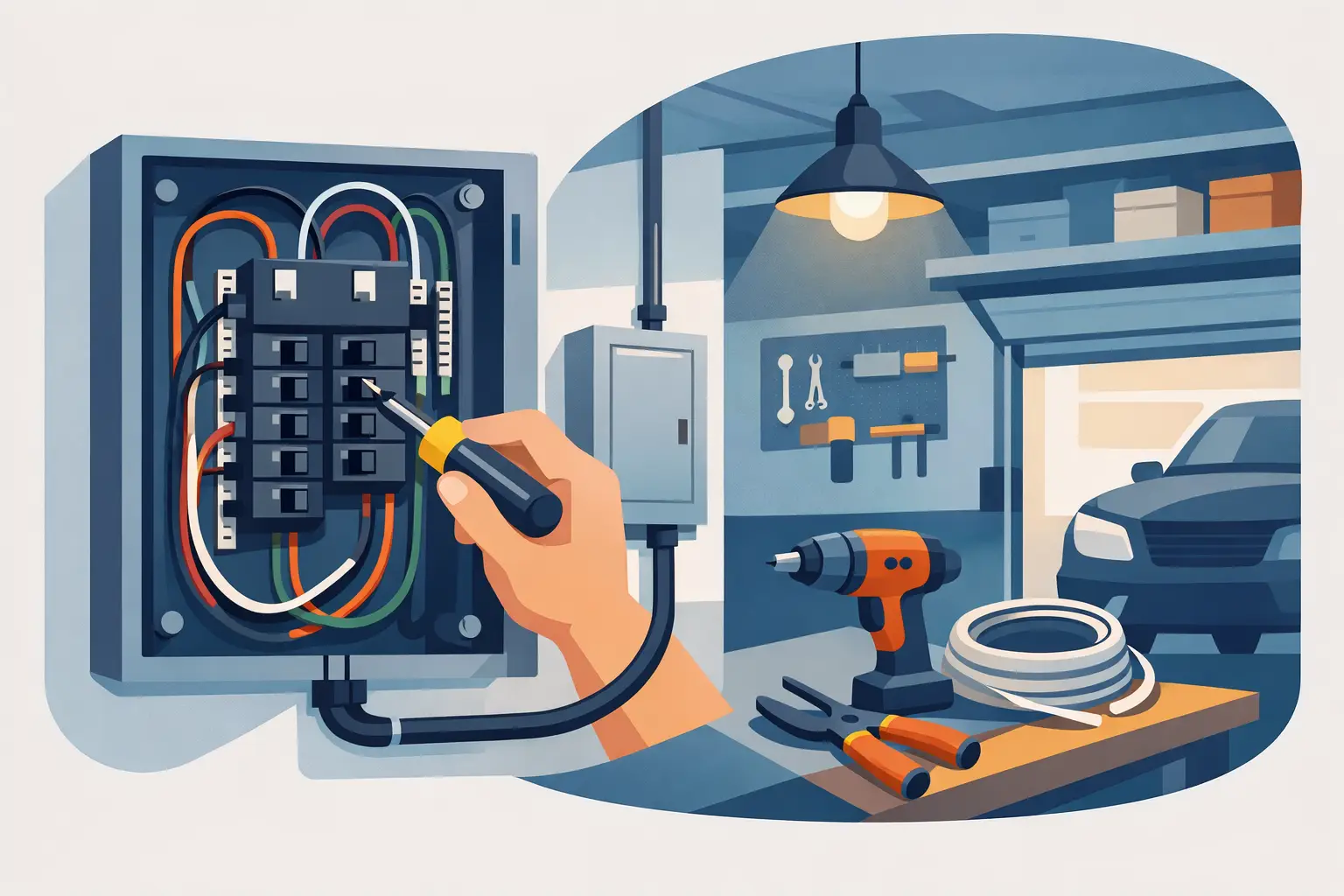
If your garage is running on one overloaded circuit and a tangle of extension cords, the problem usually is not the tools. It is the power supply. Garage sub panel installation gives that space its own electrical distribution point, which can make a big difference for workshop equipment, freezers, lighting, and future upgrades like an EV charger.
For many homeowners, the garage starts as a place to park and slowly becomes something more. It turns into a workshop, a home gym, extra storage, or a charging area for electric vehicles. That change puts real demand on your electrical system. A properly planned sub panel can support that demand more safely and more reliably than trying to keep adding circuits to an already busy main panel.
What a garage sub panel installation actually does
A sub panel is a smaller electrical panel fed from your home’s main service panel. It does not increase the total power coming into the house by itself, but it creates a dedicated point for managing circuits in a separate area. In a garage, that often means better organization, easier expansion, and fewer problems caused by overloading shared circuits.
Instead of running every new garage circuit all the way back to the main panel, the sub panel becomes the local hub. That matters when the garage is detached, when the main panel is full, or when you need several new circuits at once. It can also make future electrical work simpler because additional circuits can be added from the sub panel if the overall service has enough capacity.
This is where homeowners sometimes get mixed messages. A sub panel is not always the right answer. If you only need one new 120-volt circuit for a garage door opener or a few receptacles, a direct circuit from the main panel may be enough. But if you are adding multiple tools, 240-volt equipment, climate control, or vehicle charging, a sub panel often makes more sense.
When a garage sub panel makes sense
The strongest case for a garage sub panel installation is when the garage needs to function like a real powered workspace rather than a basic storage area. That includes garages with table saws, air compressors, welders, refrigerators, dedicated lighting, or EV charging equipment.
Detached garages are another common reason. Running a feeder to a sub panel in the detached structure is usually more practical than trying to run several separate branch circuits over that distance. It creates a cleaner, more serviceable setup.
It also helps when your existing main panel is crowded. In older homes, available breaker space can disappear fast. A sub panel can improve circuit organization, but there is a trade-off. If the main service itself is undersized, adding a sub panel may not solve the larger issue. In that case, the better long-term move could be a main panel upgrade first.
Planning matters more than panel size alone
Homeowners often ask what size sub panel they need. The honest answer is that it depends on the actual load, not just what sounds future-proof. A panel that is too small can limit the garage almost immediately. A panel that is oversized without regard to the home’s service capacity can create planning problems of its own.
A licensed electrician will typically look at the garage’s intended use, the existing service capacity, the distance from the main panel, and the type of loads you expect to run at the same time. A garage used for basic lighting and receptacles may need something very different from a garage set up for woodworking, a mini-split system, and EV charging.
That is why load calculations matter. They help determine whether your home can support the new feeder and whether the project should include a broader panel evaluation. For homeowners in areas with hot summers like the Antelope Valley, that planning is especially important when garage spaces also include cooling equipment or refrigerators that need dependable power.
Safety and code issues are a big part of the job
Garage electrical work is not just about adding capacity. It also has to be installed correctly for safety. A sub panel has specific grounding and bonding requirements, and those details matter. The same goes for breaker sizing, conductor sizing, conduit or cable protection, and the way circuits are distributed.
Garages also have their own code considerations. Receptacle placement, GFCI protection, AFCI requirements where applicable, lighting, and dedicated circuits for certain equipment all come into play. Detached garages can add another layer, especially if grounding electrodes or trenching are involved.
From a homeowner’s point of view, the takeaway is simple. This is not a shortcut project. It needs to be done with a full understanding of the home’s electrical system, local code requirements, and the way the garage will actually be used. Quality and safety are tied together here.
Common upgrades paired with garage sub panel installation
Many homeowners do not install a garage sub panel just for the panel itself. They do it because they are planning several improvements at once. That can include adding more wall receptacles, brighter LED lighting, 240-volt circuits for equipment, or a dedicated EV charger circuit.
This is often the smartest time to think ahead. If you know the garage may later need a charger, a freezer, or workshop equipment, it is usually better to plan for those loads during the initial project. That does not mean overspending on features you will never use. It means avoiding a setup that is maxed out the day it is installed.
There is a balance, though. Not every garage needs to be outfitted like a commercial shop. For many homes, the goal is simply a safer, cleaner setup with room for normal daily use and a little future flexibility.
What the installation process usually involves
Most garage sub panel installation projects begin with an assessment of the main service panel and the garage’s expected electrical demand. The electrician checks available capacity, looks at the route for the feeder, and identifies whether the garage is attached or detached.
From there, the work may involve installing a feeder breaker at the main panel, running conductors to the garage, mounting the sub panel, separating neutrals and grounds correctly in the sub panel, and then adding or relocating the necessary branch circuits. In some cases, drywall access, trenching, or surface-mounted conduit may be part of the job.
Permitting and inspection are also part of doing the work properly. Homeowners sometimes see that as an extra step, but it is an important one. It helps verify that the installation meets code and supports safe long-term performance.
Once the panel is in place, the benefit is not just more power. It is easier control, better circuit layout, and a garage that functions more like a usable part of the home.
Signs your garage may need more than a simple circuit addition
Some problems point toward the need for a broader electrical solution. If breakers trip when multiple devices run at once, lights dim when tools start, or you rely on extension cords because there are not enough outlets, the current setup may be underbuilt for the way you use the space.
The same is true if you are planning a remodel or adding high-demand equipment. A new welder, air compressor, or Level 2 EV charger changes the conversation quickly. At that point, adding one more circuit may not be the cleanest or safest path.
A trusted electrical repair professional can help determine whether the better answer is a new branch circuit, a sub panel, or a service upgrade. The right choice depends on the whole house, not just the garage.
Choosing the right electrician for garage sub panel installation
This is the kind of project where experience matters. A clean-looking panel is not enough. The work should reflect accurate load planning, code-conscious installation, and a practical understanding of how homeowners use garage spaces over time.
Ask whether the electrician handles panel-related work regularly, whether permits are included when required, and whether the installation is being planned for current and future use. A careful contractor will talk through the trade-offs instead of pushing the same solution for every home.
For homeowners who want dependable results, the goal is straightforward: safe power, room to use the garage the way you want, and confidence that the system is built to last. That is the value of getting the job done right the first time.
A garage should not be the part of the house where electrical compromises pile up. If the space is becoming more useful, the power serving it should keep pace in a safe, reliable way.
Leave a Reply