
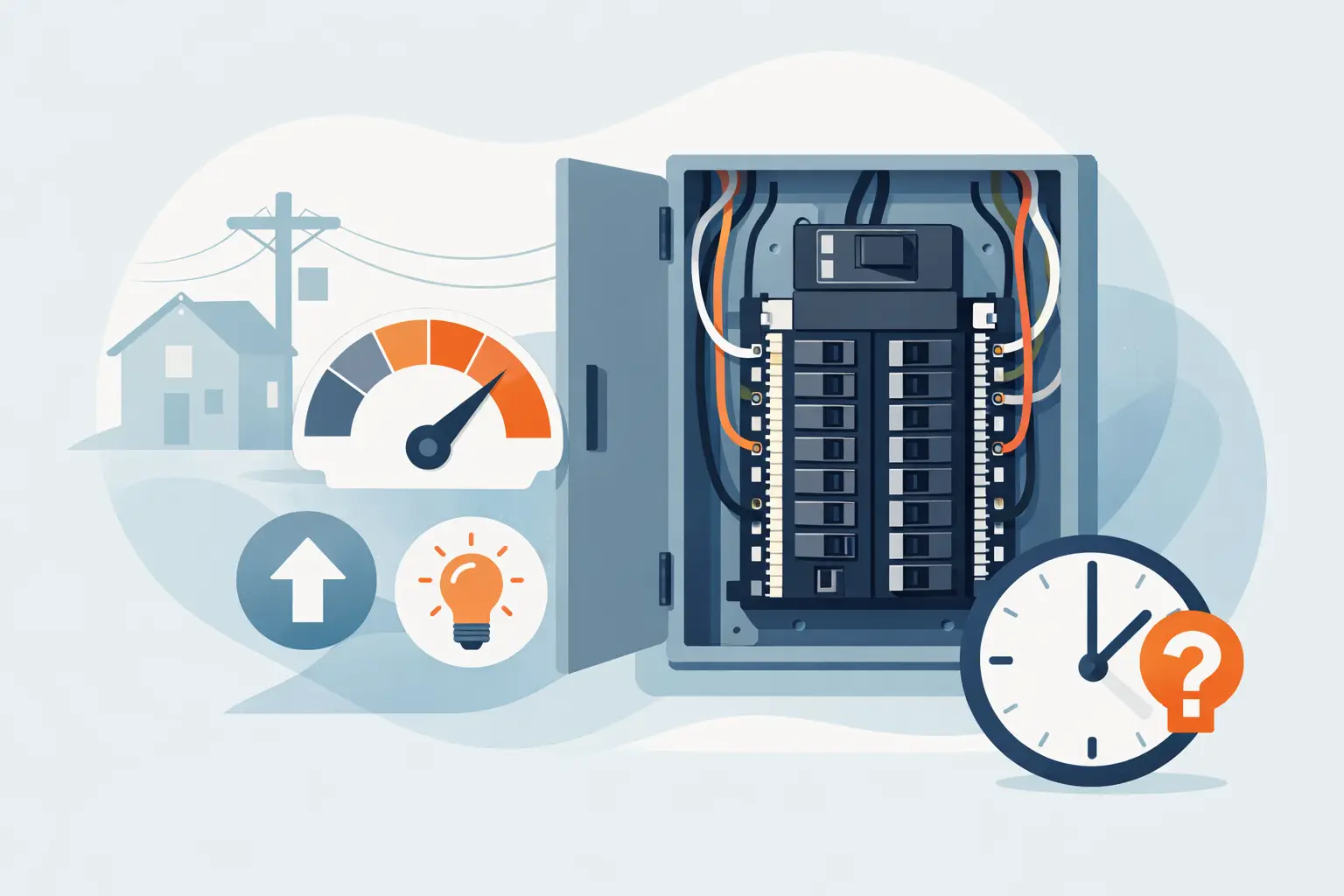
If your lights dim when the AC starts, or you are planning an EV charger, a 200 amp panel upgrade may be more than a nice-to-have. For many homeowners, it is the point where an older electrical system stops keeping up with how the house is actually used.
A panel upgrade is not about chasing bigger numbers. It is about making sure your home can safely handle daily demand without overloaded circuits, nuisance breaker trips, or limitations every time you want to add something new. In older homes especially, the electrical panel often becomes the bottleneck long before the rest of the house shows obvious signs of trouble.
What a 200 amp panel upgrade actually means
Your electrical panel is the control center for the home. It receives power from the utility and distributes it across the circuits that serve lighting, outlets, appliances, HVAC equipment, and newer loads such as EV chargers or hot tubs.
A 200 amp panel upgrade usually means replacing an older, lower-capacity panel – often 100 amp or 125 amp service – with equipment designed to handle more electrical demand. In some homes, that includes a full service upgrade with meter work, grounding updates, new breakers, and coordination with the utility. In others, the work may be more limited. That depends on the age of the system, local code requirements, and whether the existing service equipment can remain.
For a homeowner, the practical question is simple: can your electrical system safely support the way you live now and the way you plan to use the house over the next several years?
Signs your home may be ready for a 200 amp panel upgrade
Some homes clearly need more capacity. Others are in a gray area where the issue is less about immediate failure and more about future limitations.
Frequent breaker trips are one of the most common signs. If circuits trip regularly during normal use, the problem may be circuit-specific, but it can also point to a panel and service that are stretched too thin. Flickering or dimming lights, especially when large appliances cycle on, can also suggest that the system is under strain.
Age matters too. Many older homes were built for a much smaller electrical load. Decades ago, families were not charging vehicles at home, running multiple large TVs and computers, or relying on high-demand HVAC systems during long summer heat. In areas like Palmdale and Lancaster, where air conditioning is not optional for much of the year, that added demand can expose the limits of an outdated panel quickly.
A planned remodel is another major trigger. If you are adding a kitchen appliance, converting a garage, installing a new HVAC unit, or putting in an EV charger, your existing panel may not have the capacity or physical space needed for the added circuits.
Why many homeowners choose 200 amps
A 200 amp service gives a home more room to operate safely and more flexibility for the future. That does not mean every house needs it, but many modern households benefit from it.
The biggest advantage is capacity. A larger service can better support central air, electric ranges, dryers, water heaters, workshops, pool equipment, and EV charging without forcing everything to compete for limited electrical supply. It also makes it easier to add dedicated circuits where they belong rather than relying on overloaded shared circuits.
There is also a safety benefit. An older or undersized panel can lead to recurring overloads, overheated connections, and workarounds that are never a good idea. A properly designed upgrade gives the home a safer foundation for normal use.
Convenience matters too. Homeowners often start looking at the panel only when they cannot add one more circuit. A 200 amp panel upgrade can remove that bottleneck and make future projects more straightforward.
When a 200 amp panel upgrade may not be necessary
Not every home needs this upgrade, and a good electrician should say that clearly.
If your home is smaller, uses gas for major appliances, and has no plans for high-demand additions, your existing service may still be adequate. In some cases, the issue is not total service capacity at all. It may be a faulty breaker, a circuit imbalance, deteriorated wiring, or an old panel brand with known reliability problems.
That is why a proper evaluation matters. The right recommendation comes from looking at the whole system, not just assuming bigger is always better. Capacity, panel condition, age, available breaker space, and future plans all factor into the decision.
What is involved in the upgrade process
From the homeowner side, the process is usually more manageable than expected, but it does require planning.
The job typically begins with an inspection of the existing electrical system and a load calculation to determine what the home needs. If a 200 amp panel upgrade is the right move, the scope may include replacing the main panel, updating the meter socket if required, improving grounding and bonding, and making sure the installation meets current code.
Permits are generally part of the process, and the utility may need to coordinate a temporary power shutoff and reconnection. Because of that, there is usually some downtime during the installation day. A professional crew plans around that and works to restore service as efficiently as possible.
For homeowners, the main point is this: panel work is not a handyman project. It affects the safety of the entire home and has to be done with careful attention to code, load planning, and utility coordination.
Cost factors homeowners should expect
The cost of a panel upgrade varies because homes vary.
The panel itself is only one piece of the total. Pricing can also be affected by permit requirements, utility coordination, grounding upgrades, the condition of existing wiring, meter equipment, wall repairs, and whether the service entrance needs to be replaced. If the home has older equipment that no longer meets code, the final scope may be broader than a simple panel swap.
That is why online price ranges can be misleading. Two homes on the same street may need very different work. A reliable estimate should reflect the actual condition of your system and the goals for your home, not just a generic package.
Panel upgrades and EV chargers often go together
A lot of homeowners start asking about service capacity when they buy an electric vehicle. That makes sense. Level 2 charging adds a significant electrical load, and not every older panel can support it comfortably.
Sometimes an EV charger can be added without a full service upgrade. Other times, a 200 amp panel upgrade is the cleaner, safer long-term solution, especially if the house already has heavy electrical use. If you are thinking about an EV charger and your panel is older, it makes sense to look at both at the same time. That can prevent duplicate work and help you plan for the home as a whole.
The value of doing it before there is a problem
Many electrical issues give subtle warnings before they become urgent. A panel that is full, outdated, or running close to its limits may continue working for a while, but that does not mean it is serving the home well.
Upgrading before a major failure can give you more options, better scheduling, and less disruption. It can also make other home improvements easier to complete. For families focused on safety, comfort, and reliable power through every season, that kind of planning pays off.
A1 Home Electric has worked with homeowners across the Antelope Valley since 2006, and one pattern shows up again and again: people are relieved once their panel finally matches the way they live. The house feels more dependable because it is.
Choosing the right electrician for panel work
This is one job where experience matters. You want a licensed residential electrician who understands panel replacements, service upgrades, permitting, inspections, and the practical realities of working on occupied homes.
Just as important, you want clear communication. A trustworthy contractor should be able to explain whether you truly need 200 amps, what is included in the work, what may change once the system is opened up, and how the upgrade supports your current and future electrical needs.
The best panel upgrade is not the one with the biggest sales pitch. It is the one that solves the right problem, meets code, and gives your home safe, reliable performance for years to come.
If your panel is showing its age, your breakers are working overtime, or your next home project depends on more electrical capacity, this is a good time to ask questions before the system forces the issue.
Leave a Reply