

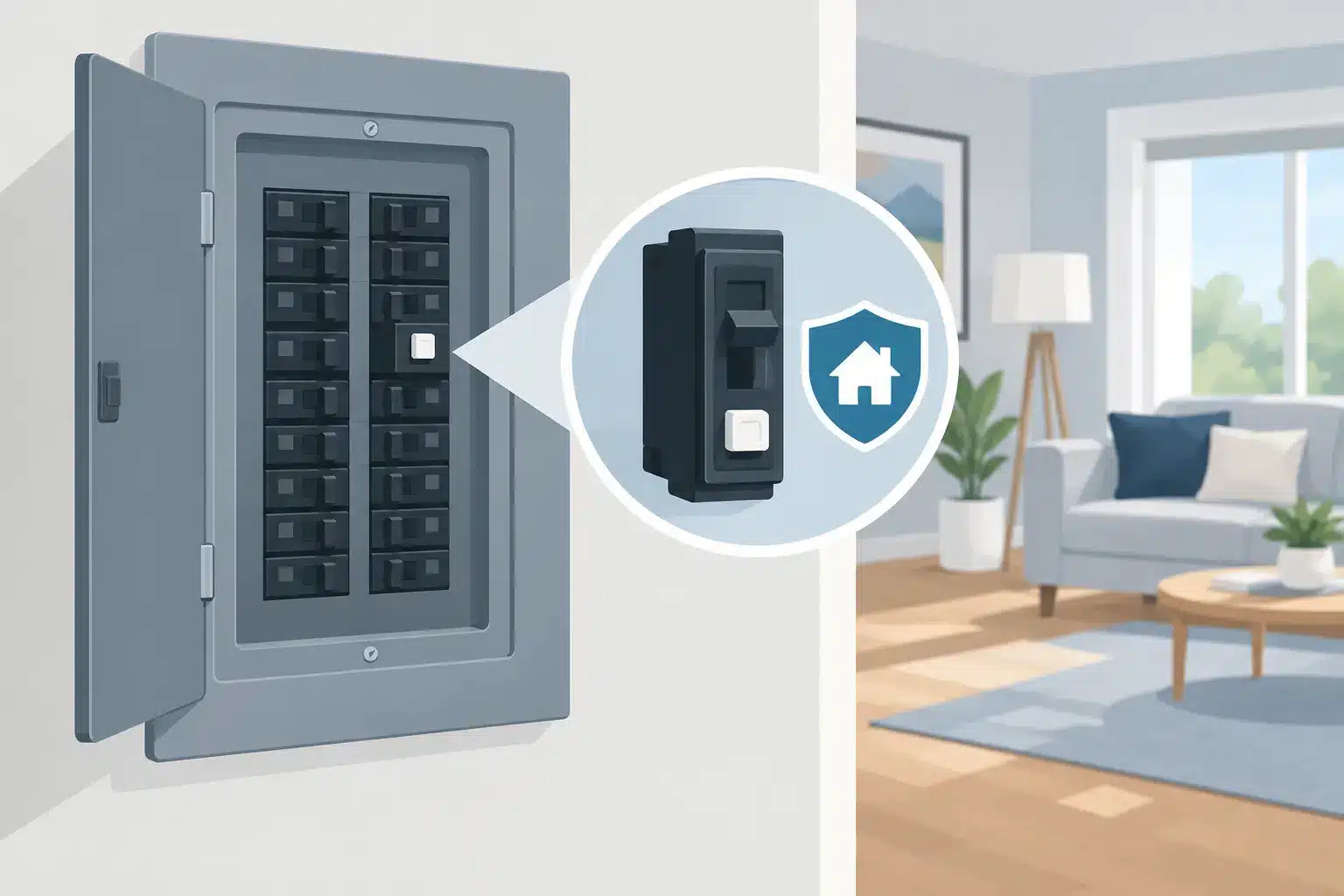
A panel upgrade, remodel, or breaker replacement can bring arc fault breaker requirements into the conversation quickly. For homeowners, the key point is simple: arc-fault protection is designed to detect dangerous electrical arcing that ordinary breakers may not catch before heat and fire risk develop. Whether your home is in Palmdale, Lancaster, or elsewhere in the Antelope Valley, the right answer depends on the circuit, the scope of work, and the electrical code enforced for the project.
What Is an Arc Fault Breaker?
An arc-fault circuit interrupter, commonly called an AFCI breaker or arc fault breaker, monitors the electrical pattern on a circuit. It is built to recognize signs of unintended arcing, such as a damaged wire, loose connection, worn cord, or faulty device connection. When it detects a hazardous arc pattern, it shuts off power to help reduce the chance of an electrical fire.
A standard circuit breaker protects primarily against overloads and short circuits. A ground-fault circuit interrupter, or GFCI, protects people from electrical shock in places where water or grounding conditions increase the risk. An AFCI addresses a different concern: arcing that can create heat inside a wall, at an outlet, or along a damaged cord.
Modern homes may need all three types of protection in different places. One does not automatically replace the other.
Arc Fault Breaker Requirements in Living Areas
Current residential electrical codes generally require AFCI protection for many 120-volt, single-phase, 15- and 20-amp branch circuits in dwelling units. These are the common circuits that serve standard lighting and receptacles throughout a home.
The protected areas commonly include bedrooms, living rooms, family rooms, dining rooms, kitchens, dens, libraries, hallways, closets, laundry areas, recreation rooms, sunrooms, and similar finished spaces. The coverage is much broader than the older idea that AFCIs were only for bedroom circuits.
The exact requirements for your work should be confirmed by a licensed electrician and the local authority having jurisdiction. California electrical requirements are updated over time, and permit rules, local amendments, and the date a project is submitted can affect what applies. A repair to one circuit is not always treated the same as a full remodel or a panel replacement.
New Work Usually Has Clearer Requirements
For new construction and major renovation work, meeting current AFCI requirements is generally straightforward. The electrician identifies the applicable 15- and 20-amp circuits, installs approved AFCI protection, and verifies that the equipment is compatible with the panel and wiring method.
This is often the right time to correct older electrical concerns as well. If the project opens walls, adds circuits, replaces a subpanel, or upgrades service equipment, a careful review can prevent surprises during inspection and improve long-term safety.
Existing Homes Are More Situational
A home does not necessarily need a whole-house AFCI upgrade simply because newer code rules exist. Existing installations may be allowed to remain as they are when no changes are being made.
However, extending, replacing, or modifying a branch circuit can trigger current protection requirements. Replacing a damaged receptacle is different from adding outlets across a room, and replacing a panel can require a broader evaluation than replacing one failed breaker. The work scope matters.
This is one reason homeowners should avoid assuming that a breaker can be swapped without further review. A qualified electrician can assess the circuit, the panel, the planned work, and local permit requirements before recommending a solution.
Where AFCI Protection May Not Be Required
Not every circuit in a home falls under the same AFCI rules. Bathrooms, garages, unfinished basements, outdoor areas, and certain dedicated equipment circuits may have different requirements. Some of those locations need GFCI protection instead, while some specialty equipment may have manufacturer instructions or code exceptions that control the installation.
For example, a kitchen countertop receptacle circuit may require both AFCI and GFCI protection. That protection can be provided in more than one approved way, depending on the circuit design and equipment. A bathroom receptacle circuit is often governed mainly by GFCI requirements, but the full installation still has to meet applicable code rules.
This is where general online advice can be misleading. The room alone does not always determine the answer. The circuit rating, what it serves, whether it is new or existing, and the type of work being performed all matter.
What Type of AFCI Protection Is Used?
For most residential panel work, a combination-type AFCI breaker is the common solution. Despite the name, it does not mean a combined AFCI/GFCI breaker. “Combination type” refers to the types of arcing it is designed to detect.
Some panels can use dual-function breakers that provide both AFCI and GFCI protection. These can be useful where both protections are required, but they must be specifically listed for the electrical panel. Breakers are not interchangeable simply because they appear to fit physically.
An electrician may also use an AFCI receptacle in limited, code-approved situations. Still, breaker-level protection is often the most practical option because it protects the circuit from the panel outward and makes future troubleshooting more consistent.
Common Issues That Affect an AFCI Installation
AFCI breakers are sensitive by design. When one trips, it may be responding to a real wiring problem, a damaged appliance cord, a loose neutral, or an issue on a shared circuit. Repeated tripping should be treated as a reason to investigate, not as an inconvenience to work around.
Older homes can present additional challenges. Loose connections, worn outlets, aging aluminum wiring, improperly shared neutrals, and do-it-yourself changes behind walls can all complicate an AFCI upgrade. A breaker that trips immediately after installation may point to a condition that was already present but had not been detected by the old breaker.
Multi-wire branch circuits need particular attention. These circuits share a neutral conductor between two hot wires and typically require correctly matched two-pole protection. Installing the wrong breaker or handling the neutral incorrectly can create operational and safety concerns.
Never replace an AFCI breaker with a standard breaker just to stop a trip. That can remove required protection while leaving the underlying electrical problem unresolved.
A Practical Homeowner Checklist
If you are planning electrical work, these steps can help keep the project moving in the right direction:
- Identify what work is being done, including new circuits, circuit extensions, panel replacement, or remodeling.
- Ask whether the affected circuits require AFCI protection, GFCI protection, or both.
- Confirm that any replacement breaker is listed for your specific panel brand and model.
- Address repeated breaker trips with electrical diagnosis instead of repeated resets.
- Use a licensed electrician when panel work, permit requirements, or older wiring is involved.
A reliable diagnosis begins with the whole circuit, not only the breaker. That may include checking devices, connections, neutral wiring, loads, and any equipment plugged into the circuit.
When to Schedule an Electrical Inspection
Consider an electrical inspection if breakers trip without a clear cause, lights flicker, outlets feel warm, you notice a burning odor, or you are preparing for a remodel. Inspection is also worthwhile before adding high-demand equipment such as an EV charger, since panel capacity and circuit layout may need attention at the same time.
Homes built decades ago can still be safe and dependable, but they benefit from informed maintenance. An electrician can determine whether an AFCI upgrade is required for planned work, advisable for a specific safety concern, or unnecessary at the present time.
A1 Home Electric helps homeowners make practical decisions about panels, circuits, repairs, and code-conscious upgrades. The best next step is not to guess which breaker belongs in the panel, but to have the circuit evaluated so your home stays protected and your electrical system remains dependable.