
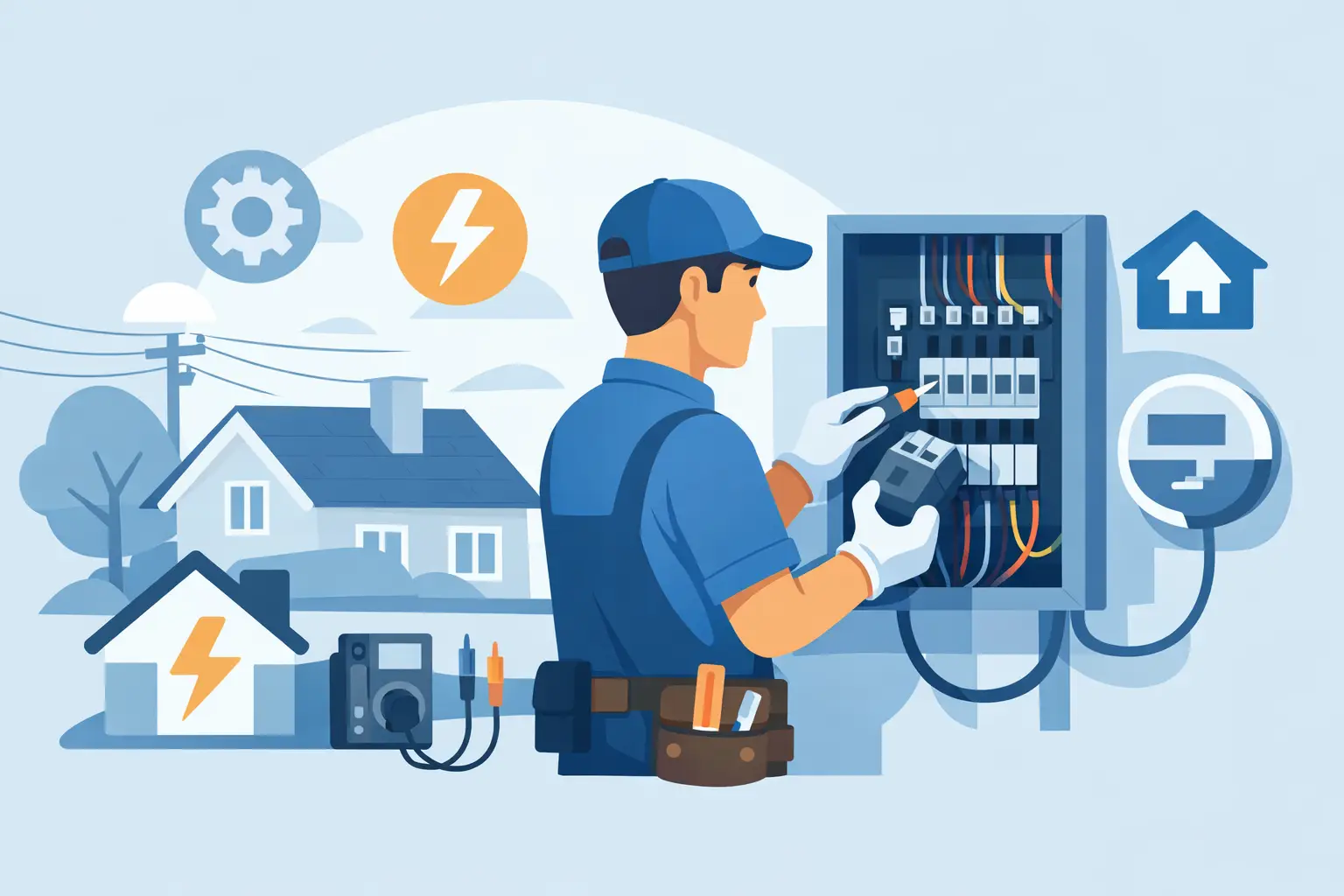
That moment usually starts small – a breaker trips when the microwave and space heater run at the same time, or the lights dim when the AC kicks on. For many homeowners, that is when a residential panel upgrade guide becomes useful, not because the panel suddenly failed, but because the home is asking for more power than the system was built to handle.
Your electrical panel is the control center for the house. It distributes power to lighting, outlets, appliances, HVAC equipment, and now, in many homes, EV chargers and other high-demand additions. When the panel is outdated, damaged, undersized, or simply full, the result is not just inconvenience. It can affect safety, reliability, and the way your home functions day to day.
What a panel upgrade really means
A panel upgrade is not just swapping out one metal box for another. In most homes, it means replacing an older or undersized service panel with one that can safely handle current electrical demand. That can include new breakers, updated grounding and bonding, code-related corrections, and in some cases coordination with the utility if the service itself needs to be increased.
For homeowners, the practical question is simple: can the electrical system safely support the way you live now? If the answer is no, a panel upgrade is often the right next step.
This matters even more in homes that have been added onto, remodeled, or updated over time. A house built decades ago may have been designed for a much lighter electrical load. Once you add central air, newer kitchen appliances, home office equipment, a workshop, hot tub, or EV charger, the old setup may start showing its limits.
Signs you may need a residential panel upgrade
Some warning signs are obvious, and some are easy to ignore because the house still “mostly works.” Repeated breaker trips are one of the clearest signals. A breaker is there to protect the circuit, so if it keeps tripping, the system is telling you something.
Flickering or dimming lights can also point to trouble, especially if it happens when larger appliances start up. If breakers feel hot, the panel smells burnt, or you hear buzzing near the panel, those are stronger warning signs that should not be brushed off.
Age matters too. Older panels may not meet the needs of a modern household, and certain discontinued panel brands have a history of safety concerns. In other homes, the problem is less dramatic but just as limiting – the panel has no room for additional circuits. That becomes a real issue when you want to add an EV charger, upgrade HVAC equipment, install new kitchen appliances, or complete a remodel.
If you are relying on extension cords, power strips, or workarounds because the home does not have enough capacity where you need it, that is often part of a bigger electrical planning problem.
Why older homes run into panel problems
In many neighborhoods across the Antelope Valley, homeowners are living in properties that were built for a different era of electrical use. Decades ago, families had fewer major appliances, less electronics use, and no need to plan around EV charging. A 100-amp service may have been enough then. It may not be enough now.
That does not mean every older home automatically needs a full upgrade. Some homes are still functioning well within their electrical demand. Others only need a subpanel, a dedicated circuit, or targeted repairs. The right answer depends on the size of the home, the service capacity, the condition of the existing panel, and what you expect the system to support in the next several years.
That last part matters. If you are already planning future upgrades, it often makes more sense to size the panel for where the home is going, not just where it is today.
What happens during a panel upgrade
A good panel upgrade starts with an evaluation, not a guess. A licensed electrician looks at the existing panel, service size, circuit layout, grounding, overall condition, and expected load. This helps determine whether you need a basic panel replacement, a service upgrade, or a larger correction to bring the system up to safe working condition.
Once the scope is clear, the work usually includes removing the old panel, installing the new panel, labeling circuits clearly, and making sure the connections and protective devices are appropriate for the home. Depending on the project, permits and inspection are part of the process. Utility coordination may also be required if the service capacity is increasing.
For the homeowner, the most noticeable part is usually a temporary power shutoff during installation. A properly planned project keeps downtime as limited as possible, but it is still something to expect. The benefit is that once the work is complete, the home has a safer and more dependable electrical foundation.
Choosing the right panel size
This is one area where bigger is not always better, but too small can create immediate limits. Many homeowners ask whether they should move from 100 amps to 200 amps. In a lot of modern households, 200-amp service is a practical choice because it leaves room for larger HVAC loads, kitchen upgrades, additions, and EV charging.
Still, it depends on the property. A smaller home with modest usage may not need the same service size as a larger home with multiple high-demand systems. The goal is not to overspend for capacity you will never use. The goal is to install a system that handles your current load safely and gives you reasonable room to grow.
This is where load calculations matter. The right decision should be based on how the home is actually used, not on rough estimates or assumptions.
The cost question homeowners always ask
Panel upgrade costs vary because no two homes are exactly alike. The final price can be affected by the panel size, age of the home, existing wiring condition, permit requirements, grounding updates, utility coordination, and whether any hidden issues are uncovered once work begins.
That uncertainty is one reason homeowners sometimes delay the project. But waiting has its own cost if the panel is already creating safety concerns or limiting needed improvements. If you are planning an EV charger, major appliance upgrade, remodel, or HVAC replacement, it is often more efficient to address the panel first rather than discovering halfway through that the electrical service cannot support the project.
A trustworthy estimate should explain what is included and why. Homeowners do not need unnecessary complexity, but they do deserve a clear picture of the work, the safety issues being addressed, and the expected result.
A few trade-offs worth understanding
Not every panel issue calls for the biggest possible upgrade. Sometimes a homeowner wants a full service increase when the more practical solution is a subpanel or better circuit distribution. In other cases, replacing a worn or obsolete panel without increasing service size may still solve a serious reliability problem.
There is also a timing trade-off. If your panel is functioning but fully loaded, you may be able to wait until a planned home improvement project begins. If the panel is showing heat damage, corrosion, arcing signs, or repeated performance issues, waiting is riskier.
Homeowners are often balancing budget, timing, and future plans. The right recommendation should reflect all three, not just the electrical ideal on paper.
How to prepare for a panel upgrade
The best preparation is to think beyond the panel itself. Consider what you want the home to support over the next five to ten years. Are you planning to add an EV charger, a new HVAC system, kitchen upgrades, a workshop circuit, or backyard electrical features? Mentioning those plans during an inspection helps shape a smarter recommendation.
It also helps to note the problems you have already seen. Breakers that trip, rooms that seem overloaded, flickering lights, dead outlets, or unusual panel behavior all give useful clues. Even if the problem feels minor, it can help identify whether the issue is isolated to one circuit or tied to the panel more broadly.
If your home has an older electrical system and you are unsure where to start, a professional inspection can clarify whether you need a full upgrade now or simply need a plan for future work.
Residential panel upgrade guide for safer long-term performance
A panel upgrade is not the most visible improvement you can make to a home, but it may be one of the most important. It supports the systems you rely on every day, helps reduce electrical stress, and gives future projects a stable foundation.
For homeowners who want fewer electrical problems and more confidence in their home’s power, this residential panel upgrade guide comes down to one principle: treat the panel as part of the home’s long-term safety, not just a box on the wall. When the electrical system is sized correctly and installed with care, the whole house works better – and that peace of mind is worth planning for.
If your home has started showing signs that the panel is falling behind, taking action early is usually easier than waiting for a bigger problem to force the decision.
Leave a Reply