
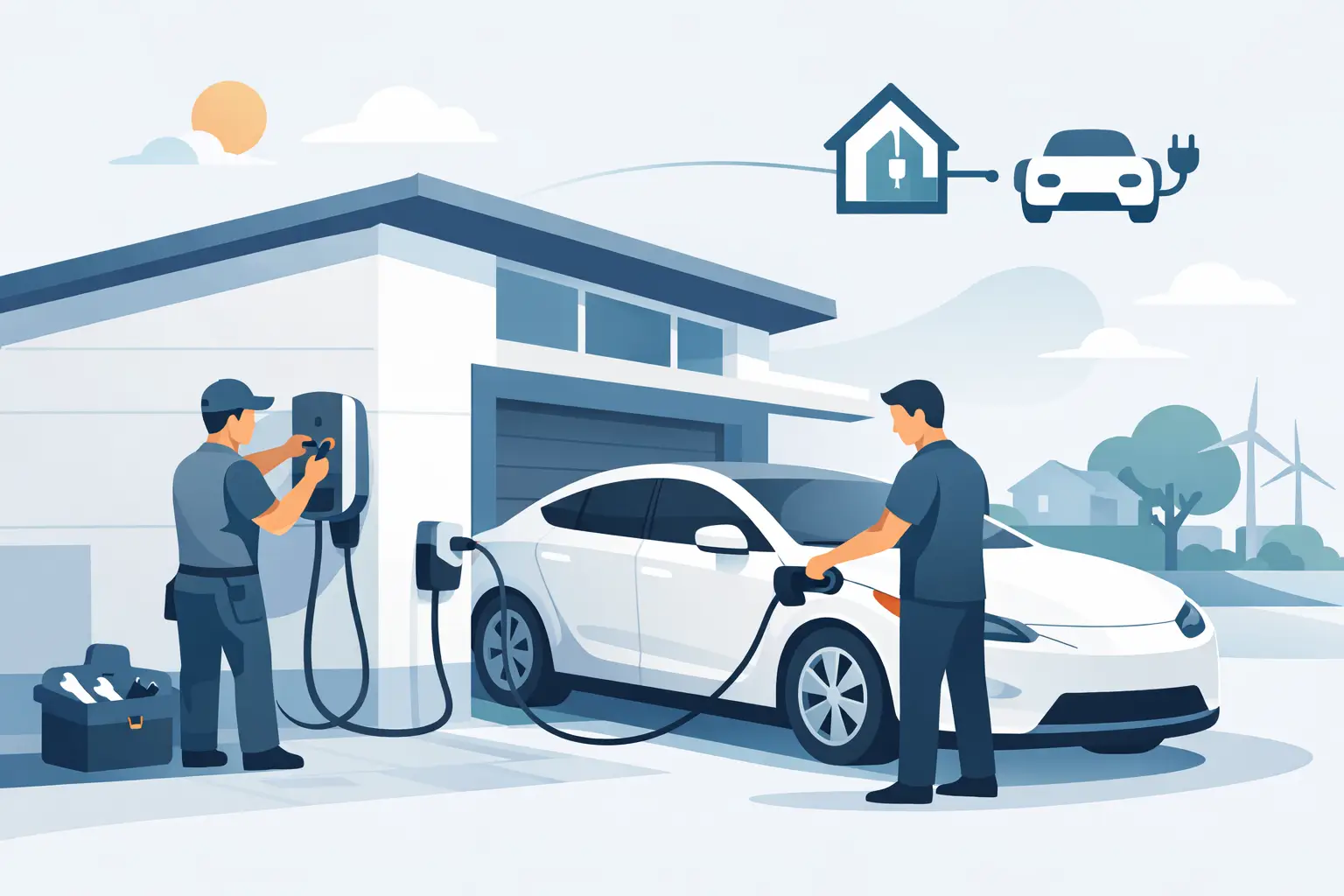
You feel the difference the first week. Instead of planning around public stations, waiting in line, or watching your battery level on the drive home, home EV charger installation gives you a simple routine: park, plug in, wake up charged. For most homeowners, that convenience is the real selling point. The question is not whether charging at home is useful. It is whether your electrical system is ready for it.
That is where the project becomes less about the car and more about the house. A charger has to fit the way your home is wired, the capacity of your electrical panel, and the location where you park every day. Done right, it is a practical upgrade that supports safety, reliability, and long-term use. Done poorly, it can create nuisance breaker trips, code issues, or unnecessary strain on an already busy panel.
What home EV charger installation really involves
Many homeowners assume the job is mostly mounting a charger on the wall. In reality, the charger itself is often the easy part. The bigger factor is whether your home can supply the power it needs without compromising other circuits.
A typical home EV charger installation starts with an evaluation of the electrical panel, available amperage, the distance from the panel to the garage or parking area, and the charging speed you want. Some homes are ready for a straightforward installation. Others need a dedicated circuit, panel adjustments, or a full service upgrade before the charger can be installed safely.
That is why two homes on the same street can have very different project scopes and costs. A newer home with room in the panel and an attached garage is usually simpler. An older home with limited panel capacity or a detached parking area may require more planning.
Level 1 vs. Level 2 charging
Most EV owners eventually focus on Level 2 charging, and for good reason. Level 1 uses a standard household outlet, which can work for light daily driving, but it is slow. If your commute is short and your vehicle sits parked for long stretches, Level 1 may be enough for now.
Level 2 charging is what most people mean when they talk about home charging. It uses a 240-volt circuit and charges much faster. For a busy household, that speed matters. It gives you more flexibility, especially if you drive daily, share the vehicle, or simply do not want to think much about charging.
The trade-off is that Level 2 requires proper electrical work. It is not a plug-and-play upgrade for every home. The electrical system has to support the added demand, and the charger has to be installed to code.
Is your panel ready for an EV charger?
This is often the most important part of the conversation. Your electrical panel is already handling air conditioning, kitchen appliances, laundry equipment, lighting, and all the other day-to-day demands of the house. Adding an EV charger means adding another major load.
If your panel has enough capacity and available breaker space, the installation may be straightforward. If it does not, you may need a panel upgrade or another approved solution to manage the load. There is no one-size-fits-all answer here. It depends on the size of your service, the age of the panel, and how much electricity your home already uses.
In the Antelope Valley, where summer heat can push HVAC systems hard, panel capacity matters even more. A home that seems fine during mild weather can feel the strain when the air conditioner is running for long hours and an EV starts charging at the same time. That does not mean you cannot install a charger. It means the system should be evaluated with real household use in mind.
Signs your home may need more than a basic installation
A few issues tend to raise flags. If your breakers trip occasionally now, if the panel is full, if the home has older electrical equipment, or if you are already planning other upgrades, the charger project may expose a bigger need. That is not bad news. It is often a chance to improve the safety and performance of the home overall.
A panel upgrade can support not just EV charging, but also future renovations, better appliance support, and more stable electrical performance. For some homeowners, that broader value makes the project easier to justify.
Choosing the right charger location
Convenience matters more than people expect. A charger should be placed where it fits your actual parking habits, not just where installation seems easiest. If you always back into the garage, that affects cable reach. If you park in a driveway, weather protection and equipment placement become more important.
The shortest run from the panel is not always the best long-term setup. Saving a little on installation can lead to daily frustration if the cord barely reaches or the charger ends up in an awkward spot. A good installation balances practical use, clean workmanship, and code compliance.
For some homes, hardwiring the charger is the better option. For others, a receptacle setup makes sense. The right choice depends on the charger model, manufacturer requirements, local code considerations, and how permanent you want the setup to be.
Cost depends on the house, not just the charger
Homeowners often ask for a simple price range, but home EV charger installation is one of those services where the condition of the home matters as much as the equipment. The charger unit itself is only one part of the total cost.
If the panel has capacity, the parking area is close, and access is simple, the project is usually more affordable. Costs go up when the electrician has to run longer wiring distances, install new breakers, upgrade the panel, work around finished walls, or bring older electrical components up to current standards.
Permits and inspections can also be part of the process, depending on the scope. That is not red tape for the sake of red tape. It is part of making sure the work meets safety requirements and performs the way it should.
Why professional installation matters
An EV charger places a sustained electrical load on your system. That is different from plugging in a small household device. Safe installation depends on proper circuit sizing, correct breaker selection, secure connections, grounding, and code compliance.
This is not a good area for shortcuts. A charger that is installed incorrectly may still appear to work at first, but hidden problems can show up later as heat buildup, equipment damage, intermittent charging issues, or safety risks. For homeowners, peace of mind comes from knowing the system was evaluated correctly and installed by a licensed professional.
That is especially true in homes with older panels, past remodel work, or unknown electrical modifications. The charger may be the reason you call, but the bigger value is getting a clear picture of whether the system is truly ready.
Home EV charger installation and everyday life
The practical benefit is not just charging speed. It is predictability. When charging is built into your routine, the car becomes easier to own. You are less dependent on public infrastructure, less likely to waste time on errands built around charging, and more confident that the vehicle will be ready when you need it.
For families, that matters. A charger can simplify morning schedules, support longer commutes, and reduce one more recurring hassle. It can also make the home feel better prepared for future needs, especially if another EV is likely down the road.
That said, bigger is not always better. Some homeowners assume they need the fastest charger available, when a moderate setup would serve them just fine. The best choice depends on your driving habits, your panel capacity, and whether you want to leave room for future electrical upgrades.
What to expect from the process
A professional installation usually begins with a site review. The electrician looks at the panel, the service capacity, the charger location, and the path for wiring. From there, you get a clearer idea of what the home can support and whether any upgrades are needed first.
Once the scope is confirmed, the installation can move forward with the right circuit, equipment mounting, and final testing. If permits are required, they should be handled as part of a code-conscious process. The goal is not just to get power to the charger. It is to install a charging setup that works safely every day.
For homeowners in Palmdale, Lancaster, and nearby communities, that local experience matters. Homes vary, weather affects usage patterns, and electrical demand can shift with the seasons. A contractor who regularly works on residential systems in the area is better positioned to spot issues before they become problems.
A1 Home Electric approaches this the way a homeowner would want it handled: start with safety, look at the whole system, and install a charger that fits the house as well as the vehicle.
If you are considering an EV charger, think beyond the equipment on the wall. The best result is a home charging setup that feels ordinary from day one – reliable, safe, and ready whenever you pull into the driveway.
Leave a Reply