
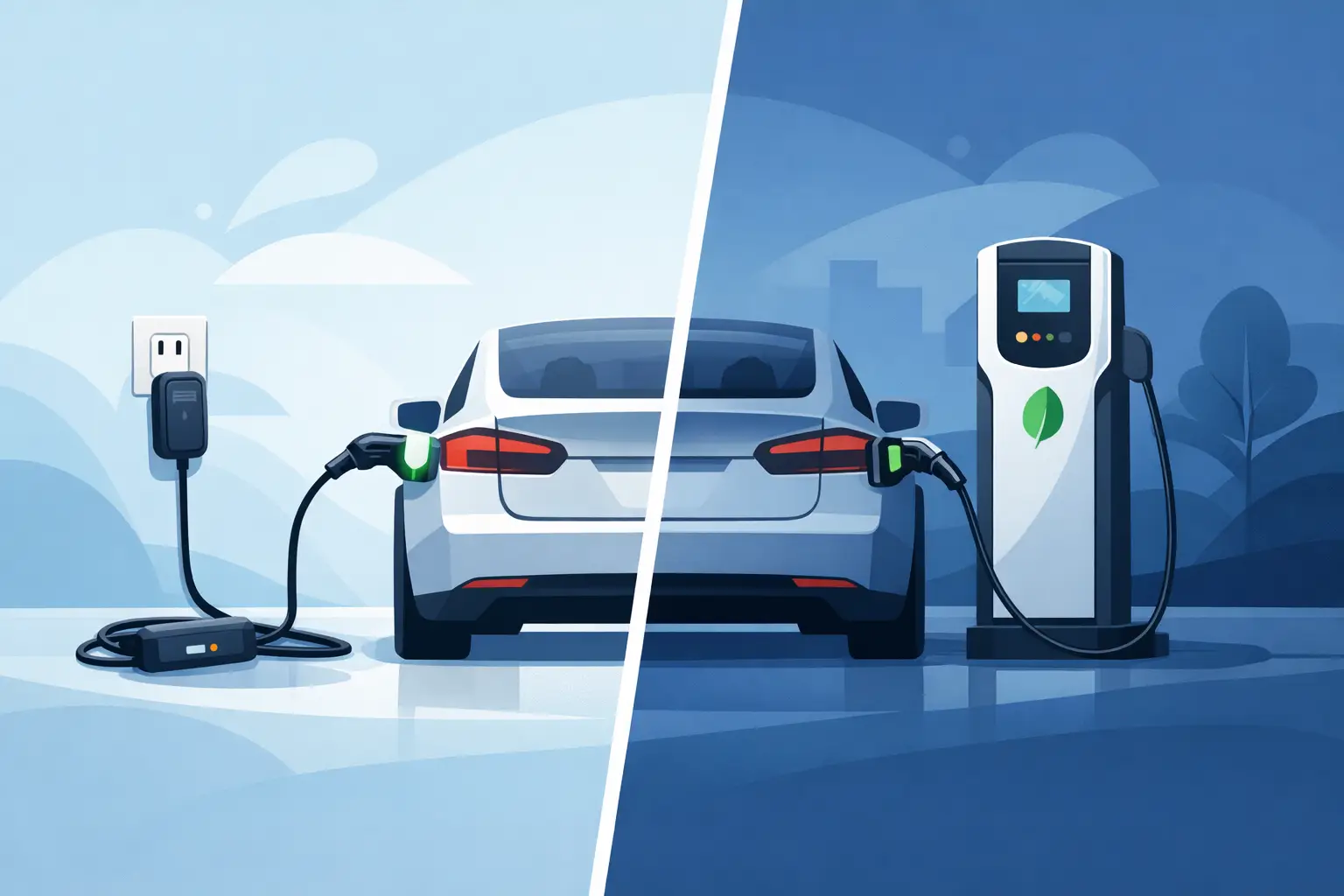
You plug in your EV at night, expect a full battery by morning, and then realize you only added a modest amount of range. That is usually the moment the question becomes real: level 1 vs level 2 charger – which one actually makes sense for your home, your driving habits, and your electrical system?
For some homeowners, a basic charging setup works just fine. For others, it quickly becomes frustrating, especially when daily mileage is higher or more than one driver needs access to charging. The right choice depends on how much you drive, how long the car sits at home, and whether your current electrical panel can support an upgrade safely.
Level 1 vs level 2 charger: the basic difference
A Level 1 charger uses a standard 120-volt household outlet. In most homes, that means plugging your EV into a regular dedicated receptacle with the charging cord that came with the vehicle. It is the simplest place to start because there is usually no new equipment installation beyond making sure the outlet and circuit are in good condition.
A Level 2 charger uses a 240-volt circuit, similar to what large appliances like electric dryers or ovens may use. This setup charges much faster, but it usually requires a dedicated circuit, the right breaker capacity, proper wiring, and in some cases a panel upgrade.
That speed difference is what drives most decisions. Level 1 charging often adds just a few miles of range per hour. Level 2 charging can add several times more, which is why many homeowners see it as the practical long-term solution rather than a convenience upgrade.
When a Level 1 charger is enough
Level 1 charging is not wrong or outdated. It is simply slower. If you drive short distances, work from home, or use your EV mostly for local trips, a Level 1 charger may cover your needs without much trouble.
This can work well for a household where the vehicle is parked for long stretches every night and the battery does not need a large daily refill. Someone driving 20 to 30 miles a day may find that Level 1 charging keeps up reasonably well, especially if the car remains plugged in consistently.
It can also make sense as a temporary solution. If you just bought an EV and want to live with it for a few weeks before investing in a 240-volt installation, Level 1 gives you a way to learn your actual charging habits first.
The trade-off is margin. With Level 1, there is less room for busy days, last-minute trips, or missed charging time. If you come home low on battery and need the car again soon, the slower charging rate can become a real limitation.
When a Level 2 charger makes more sense
A Level 2 charger is often the better fit for homeowners who want predictable overnight charging and less day-to-day planning. If you drive longer distances, have a commute, or simply want the battery recharged more quickly, Level 2 usually removes the friction.
It is especially useful for households with one or more of these situations: higher daily mileage, multiple EVs, limited time parked at home, or future plans to replace another gas vehicle with an EV. In those cases, faster charging is not just nice to have. It supports how the household actually operates.
Many homeowners also prefer Level 2 because it feels more dependable. You come home, plug in, and by morning the vehicle is ready again. That kind of consistency matters when your vehicle is part of your daily routine and not just a weekend driver.
Charging speed matters more than most people expect
On paper, the difference between Level 1 and Level 2 sounds like a technical detail. In practice, it changes how convenient EV ownership feels.
Level 1 charging is often described in terms of patience. It can take a long time to recover from a low battery, and that can be fine until your routine changes. A few extra errands, a longer commute, cold weather, or weekend driving can create a gap between what the charger provides and what the vehicle uses.
Level 2 charging is more forgiving. It gives you a stronger daily reset, which means less worry about whether tonight’s charge will be enough for tomorrow. For busy households, that peace of mind is often the biggest benefit.
The electrical side of the decision
The level 1 vs level 2 charger decision is not only about driving habits. It is also about what your home can safely support.
Level 1 charging usually places less demand on the electrical system, but that does not mean any outlet is automatically a safe long-term charging outlet. Older homes may have worn receptacles, shared circuits, or wiring conditions that should be evaluated before using them regularly for EV charging.
Level 2 charging requires more planning. The charger needs a properly sized 240-volt circuit, the right wire size, breaker protection, and an installation that matches current code requirements. The home’s panel capacity also matters. Some homes have enough available capacity already, while others may need load calculations or panel upgrades before installation.
That is where professional evaluation becomes important. A charger that works well on paper can still create problems if the panel is already full, the wiring path is difficult, or the installation is done without considering the home’s overall electrical load.
Cost now versus cost over time
Level 1 is usually cheaper at the beginning because there may be little or no installation cost. If the outlet is safe, dedicated, and well located, you may be able to start charging with what you already have.
Level 2 costs more upfront because it often involves new wiring, a dedicated circuit, permits where required, and labor. In some homes, the total project is simple. In others, especially older properties or detached garage layouts, the installation is more involved.
Still, upfront cost is only part of the picture. A Level 2 charger can be the better value over time if it saves daily hassle, supports a second EV later, or avoids the need to revisit the project after discovering Level 1 does not keep up. Many homeowners would rather install the right solution once than patch together a temporary one and upgrade later.
Which charger fits your home and routine?
If you are deciding between the two, think less about the charger itself and more about your week. How many miles do you drive on a normal day? How often does that number change? How long is the car parked at home? Will another EV likely join the household in the next few years?
If your driving is light and predictable, Level 1 may be enough. If your schedule is fuller, your mileage is higher, or you want more flexibility, Level 2 is usually the more comfortable choice.
There is also a middle ground. Some homeowners start with Level 1, then move to Level 2 after they see how often they need faster charging. That approach can work well if you want to avoid rushing the decision. The key is making sure even the temporary setup is safe and appropriate for regular use.
A home-focused way to make the choice
For homeowners in places like Palmdale and Lancaster, EV charging is not just about the car. It is about whether the garage, panel, and household electrical system are ready for one more major daily load. Heat, aging panels, older branch circuits, and growing home power demands all matter when planning a charger installation.
That is why the best decision is usually a practical one, not just the fastest or cheapest option. A properly installed charger should support your routine, protect your home, and give you confidence that the system will perform reliably over time.
If Level 1 already fits your life, there is no rule saying you must upgrade immediately. But if charging feels slow, inconvenient, or uncertain, Level 2 is often the step that makes EV ownership easier and more dependable. A good charger setup should feel simple once it is in place, and the right electrical planning is what makes that possible.
Ultimately, the level 1 vs level 2 charger choice should align with your goals for electric vehicle ownership.
Make a choice between level 1 vs level 2 charger based on your charging frequency and vehicle needs.
Consider how the level 1 vs level 2 charger fits into your daily routine for optimal results.
Your choice between a level 1 vs level 2 charger should reflect your specific lifestyle and habits.
In summary, the level 1 vs level 2 charger decision is crucial for effective EV charging.
Understanding the efficiency of a level 1 vs level 2 charger can help optimize your vehicle’s performance.
Evaluating your needs in the context of a level 1 vs level 2 charger can simplify the selection process.
Many first-time EV owners wonder about the level 1 vs level 2 charger distinctions before making a decision.
Being informed about the level 1 vs level 2 charger features can enhance your electric vehicle ownership experience.
For many, exploring the level 1 vs level 2 charger options can lead to improved efficiency in daily charging tasks.
Ultimately, the level 1 vs level 2 charger conversation is about aligning your charging setup with your lifestyle.
Analyzing the pros and cons of a level 1 vs level 2 charger helps in making an informed decision.
Many homeowners find that the level 1 vs level 2 charger choice directly affects their daily routine.
The decision between a level 1 vs level 2 charger often hinges on your specific usage needs.
Choosing the right option in the level 1 vs level 2 charger debate can save you time and improve convenience.
Understanding the differences between a level 1 vs level 2 charger can significantly impact your EV charging experience.
Leave a Reply