

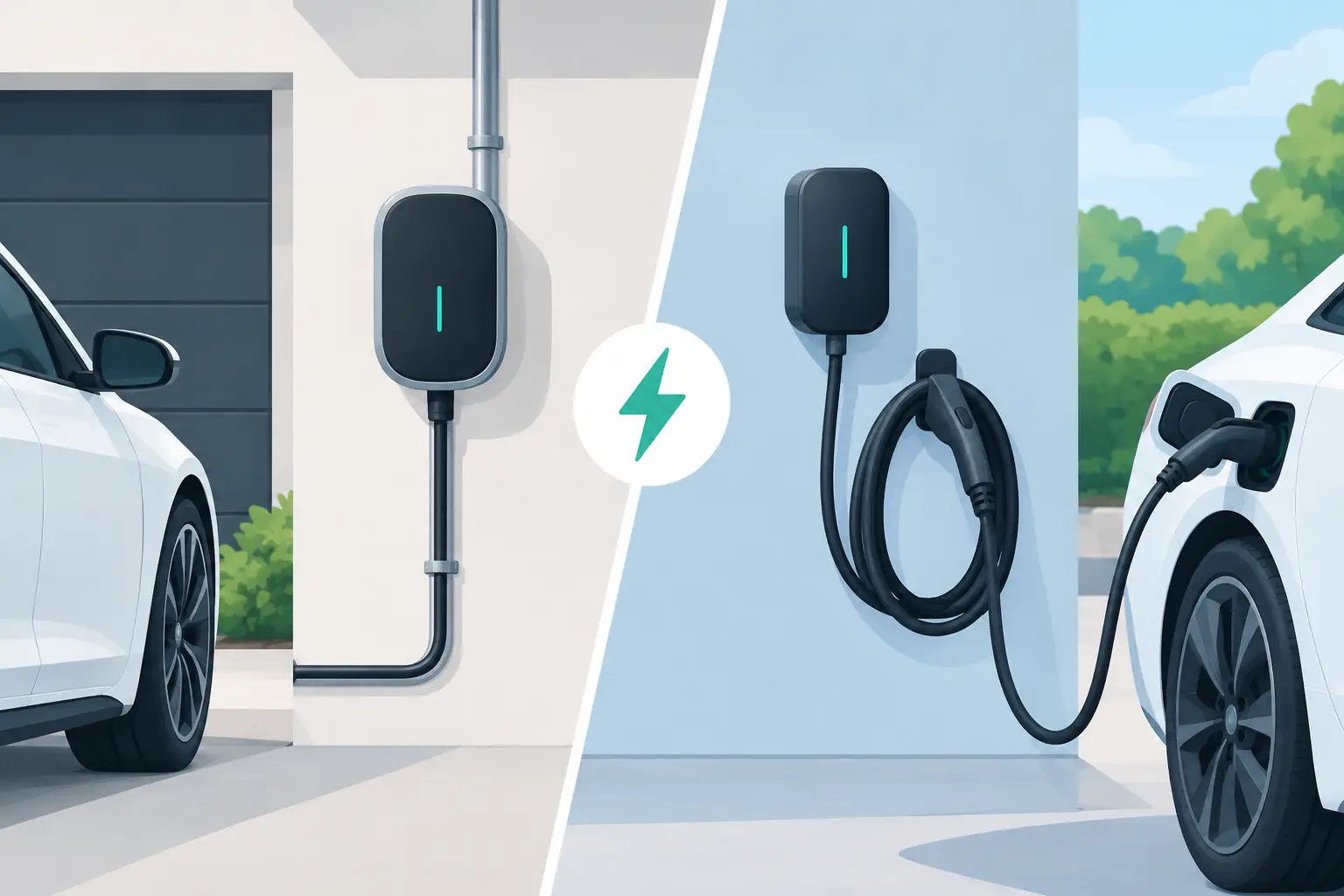
A home EV charger is more than a convenience purchase. It becomes part of your daily routine, your electrical system, and potentially your home’s resale appeal. When comparing EV charger hardwire vs plug options, the best choice depends on the charger you select, the condition of your panel, where you park, and whether you value easy replacement or the strongest permanent installation.
For many Antelope Valley homeowners, the decision also starts with an electrical capacity check. A charger may be straightforward in a newer home with available panel space, but an older panel, limited service capacity, or a full breaker box can change the scope of the work. A licensed electrician can assess the whole installation before recommending a hardwired or plug-in solution.
EV Charger Hardwire vs Plug: The Main Difference
A hardwired EV charger is permanently connected to a dedicated circuit. The charger wiring runs directly from the electrical panel to the charging unit, without a wall receptacle between them. It is a fixed installation performed by a qualified electrician.
A plug-in EV charger connects to a dedicated heavy-duty receptacle, commonly a 240-volt outlet designed for EV charging. The charging unit plugs into that receptacle and can be unplugged if the unit needs service, replacement, or relocation.
Both setups can provide dependable Level 2 charging when they are properly designed, permitted when required, and installed according to current electrical code and the charger manufacturer’s instructions. The better choice is not always the one with the highest advertised charging speed. It is the one that fits your home safely and supports the way you use your vehicle.
Why Hardwiring Is Often the Preferred Permanent Option
Hardwiring is frequently the right fit for homeowners who plan to stay in the home, have a dedicated parking location, and want a clean, durable installation. Since there is no receptacle and plug connection, there is one less connection point that can loosen, wear, or overheat over time.
A hardwired charger may also allow for a higher charging output, depending on the charger, circuit size, panel capacity, and vehicle. This does not mean every home needs the largest circuit available. Most drivers can recover their normal daily driving range overnight with a properly sized Level 2 charger. The goal is reliable charging, not unnecessary electrical load.
Hardwiring can look more finished in a garage or on an exterior wall. The conduit, disconnecting means if needed, weather protection, mounting location, and wire routing can all be planned as one installation. This is especially useful where the charger will be exposed to sun, wind, dust, or changing temperatures.
The trade-off is flexibility. If you replace the charger with a different model later, an electrician may need to adjust the wiring or mounting arrangement. That is usually manageable, but it is not as simple as unplugging one unit and plugging in another.
Hardwired charging is usually a good choice when:
A homeowner wants the cleanest long-term setup, needs a charger that is designed for higher output, or is installing charging outdoors. It is also a strong choice when the electrical system is already being upgraded and the charging equipment can be planned as part of the project.
When a Plug-In EV Charger Makes Sense
A plug-in charger can be a practical option when flexibility matters. If a charger fails after its warranty period, a homeowner may be able to replace the charging unit without changing the receptacle, as long as the replacement is compatible with the circuit and outlet configuration.
Plug-in units can also be useful for people who may move, lease a property, or want the option to take the charger with them. Real estate agents and property owners sometimes prefer this approach because the outlet can remain as a useful home feature even if the portable charging equipment is removed.
However, a plug-in installation is only as dependable as the receptacle, plug, wiring, and installation quality behind it. EV charging is a continuous load that can run for hours. A general-purpose outlet, an old receptacle, or a loose connection is not an appropriate solution for regular Level 2 charging.
The receptacle must be properly rated for the load, installed on a dedicated circuit, and mounted securely. The plug should fit tightly, and the equipment should be inspected if there are signs of heat, discoloration, cracking, or a loose connection. A charger that repeatedly trips a breaker, feels hot at the plug, or stops charging should be checked promptly rather than treated as a minor inconvenience.
Safety and Electrical Capacity Matter More Than Convenience
The EV charger itself is only one part of the installation. Your panel, main service size, existing electrical loads, and available breaker spaces all affect what can be installed safely.
An electrician may perform a load calculation to determine whether your home can support the added charging load. This review considers major appliances and equipment such as air conditioning, electric heat, dryers, ranges, water heaters, pools, spas, and existing circuits. In Palmdale and surrounding communities, summer air conditioning demand can be a meaningful part of that calculation.
If the panel does not have adequate capacity, the right answer may be a panel upgrade, a service upgrade, a lower-output charging configuration, or load management equipment. Skipping this evaluation can create nuisance tripping, overloading concerns, or work that will not pass inspection.
A quality installation also includes proper breaker sizing, conductor sizing, grounding, equipment mounting, and protection for the installation location. Outdoor equipment needs weather-rated components and careful placement. Garage installations need wiring protected from possible vehicle impact and routed neatly to avoid damage.
Permits and Inspections Are Part of a Proper Installation
EV charging work often requires a permit and inspection, particularly when a new 240-volt circuit is installed or when the electrical panel is upgraded. Permits are not simply paperwork. They provide a check that the installation is designed and completed with safety in mind.
A licensed electrician can coordinate the electrical work, permit process, and inspection requirements. If a panel or service upgrade is involved, utility coordination may also be necessary to safely shut off power and complete the work.
For qualifying customers, Southern California Edison programs may offer rebates of up to $4,200 for eligible panel upgrade and EV charger installation work. Program requirements, funding, eligibility, and available rebate amounts can change, so it is wise to confirm the current details before planning a project around an incentive. A knowledgeable local electrician can help identify whether the electrical scope may support an application and handle the installation work correctly.
Cost: Look Beyond the Charger Price
A plug-in charger may appear less expensive because the charging unit can be purchased separately and connected to an outlet. But the outlet still needs a correctly installed dedicated circuit, and a high-quality receptacle is not an area to cut corners.
A hardwired charger may cost more upfront if it requires additional electrical work, yet it can eliminate the receptacle and provide a more permanent setup. The total cost for either option is driven less by the charger style than by the distance from the panel, wall access, trenching or exterior conduit needs, panel condition, and required upgrades.
The lowest quote is not always the lowest long-term cost. EV charging places repeated demand on a circuit, so workmanship, materials, permits, and accurate load planning matter. A dependable installation protects the vehicle, the charger, and the home.
How to Choose the Right Setup for Your Home
Choose hardwiring if you want a permanent, clean installation and expect the charger to remain in one location for years. It is often the stronger choice for outdoor locations, higher-output equipment, and homeowners completing a larger electrical upgrade.
Choose a plug-in configuration if portability and simple equipment replacement are priorities, provided the outlet and circuit are installed specifically for the charging load. Do not assume an existing 240-volt outlet is automatically suitable. Its age, wiring, breaker, receptacle type, and circuit use must be evaluated first.
Before purchasing a charger, confirm the charging unit’s requirements, your vehicle’s charging capability, your daily driving needs, and your home’s available electrical capacity. A charger with more power than your home can comfortably support is not a better value.
A1 Home Electric has provided local electrical service since 2006, with licensed work performed under California license #885624. For homeowners in Palmdale, Lancaster, Quartz Hill, Littlerock, and Lake Los Angeles, a site evaluation can turn an uncertain charger decision into a clear plan that accounts for safety, code requirements, panel capacity, and available rebate opportunities.
Your EV charger should make coming home easier, not give you another electrical concern to watch. Start with a professional assessment, select the setup that fits your property and routine, and give the installation the same attention you would give any other major improvement to your home.