
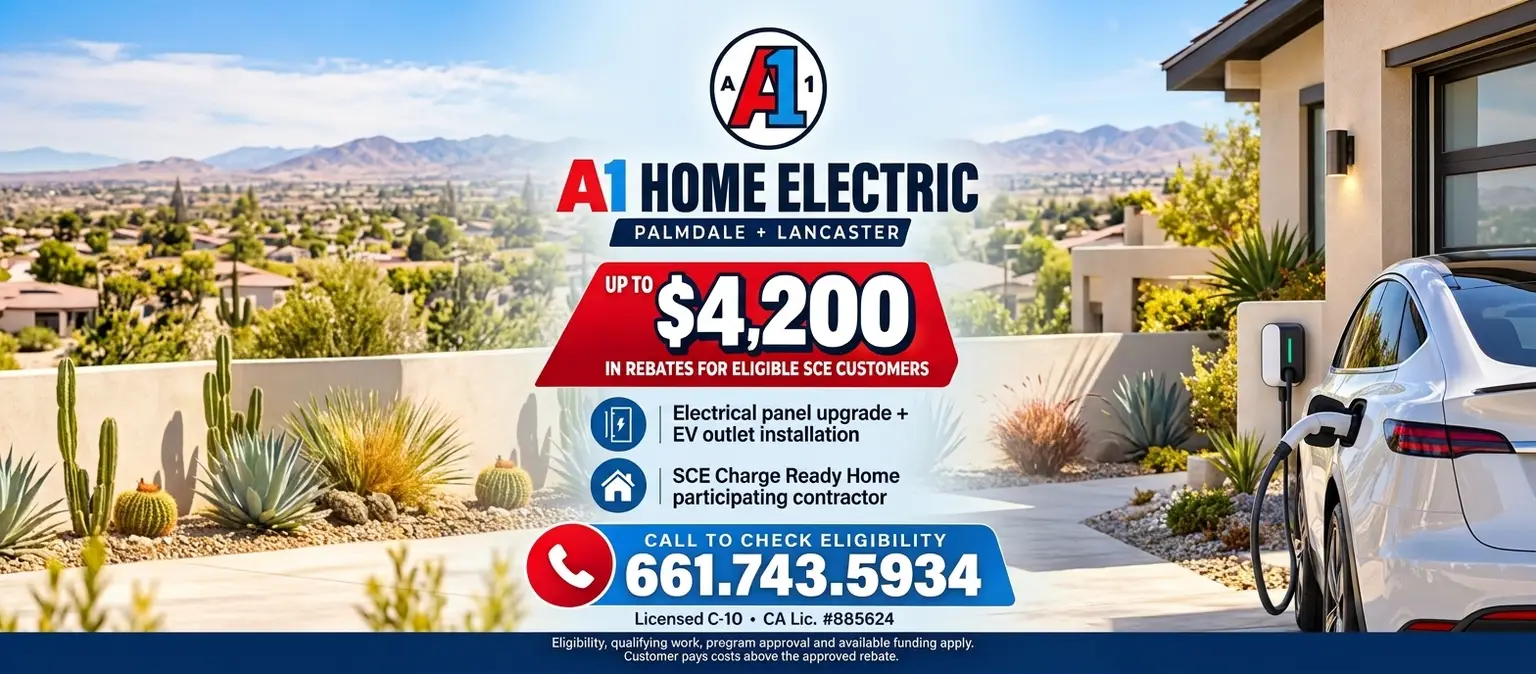
A full electrical panel is more than an inconvenience when a breaker trips. It can limit an EV charger installation, prevent needed home upgrades, and create safety concerns when the equipment is outdated or damaged. The Electric Panel Upgrade Southern California Edison Rebate may help eligible homeowners reduce the cost of improving their electrical service, with potential assistance of up to $4,200 for qualifying panel and EV charger work.
For homeowners in Palmdale, Lancaster, Quartz Hill, Littlerock, and Lake Los Angeles, the key is understanding that a rebate is not simply a discount applied at the end of a job. Eligibility, equipment requirements, permits, utility coordination, and proper documentation all matter. A licensed local electrician can help make the process clearer while completing the work with quality and safety in mind.
Electric Panel Upgrade Southern California Edison Rebate Basics
Southern California Edison rebate programs can support eligible customers who need electrical upgrades for EV charging. Depending on the current program rules and a household’s eligibility, funding may help cover a panel upgrade, service equipment work, and installation related to a qualifying electric vehicle charger. Some income-qualified homeowners may be eligible for higher levels of assistance.
The available amount can be significant, but it should never be treated as guaranteed. Rebate programs have enrollment requirements, funding limits, installation standards, and documentation deadlines. Program terms can also change. Before work begins, it is wise to confirm the current requirements and determine whether the proposed project fits the program.
A panel upgrade is often needed because an older home may have a 100-amp panel, limited breaker spaces, or electrical equipment that is no longer suitable for added loads. An EV charger can place a substantial, continuous demand on a home’s electrical system. The right solution may be a larger panel, a load-management device, a service upgrade, or another code-compliant approach based on the home’s actual capacity.
Why an Electrical Panel Upgrade May Be Needed
Your electrical panel distributes power throughout the house and protects circuits from overloads. When it is properly sized and in good condition, it supports everyday comfort: air conditioning, kitchen appliances, lighting, laundry equipment, electronics, and now electric vehicle charging.
Warning signs deserve a professional inspection. Frequent breaker trips, warm panel covers, flickering lights, rust or corrosion, buzzing sounds, burned odors, crowded wiring, or a panel with no available breaker space are not issues to ignore. The same is true when a home still has aging or problematic electrical equipment that should be evaluated for replacement.
Not every home that wants an EV charger requires a complete panel replacement. That is why an inspection comes first. A qualified electrician will review the panel rating, available capacity, service equipment, existing loads, wiring condition, and the charger being considered. This avoids paying for more work than the home needs while ensuring the installation is safe and prepared for future use.
What the Rebate Process Can Involve
A successful project starts before the first breaker is removed. The electrician needs to understand the home’s existing electrical system and the scope of the EV charging installation. From there, the homeowner can receive a clear recommendation for the needed panel, service, wiring, and charger work.
For a qualifying project, the process commonly includes confirming program eligibility, preparing an electrical plan, obtaining the required city permit, coordinating a meter shutoff with Southern California Edison when necessary, completing the upgrade, passing inspection, and submitting required rebate documents. The exact order depends on the utility program and the type of electrical work involved.
This coordination matters because a service or panel upgrade may require the meter to be de-energized before work can safely proceed. Utility scheduling and city inspection timing can affect the project schedule. Trying to skip these steps can create delays, failed inspections, or unsafe conditions.
A1 Home Electric works with Southern California Edison on eligible rebate projects and handles the practical coordination that homeowners do not want to manage alone, including permits, inspections, and meter shutoff arrangements when required. With local service since 2006 and California contractor license #885624, the focus is on dependable work that supports both the home and the rebate process.
Who May Qualify for Up to $4,200?
The highest rebate amounts are generally intended for homeowners who meet specific program and income qualifications. Income eligibility may be based on household size, location, and current program guidelines. A homeowner may also need to own and occupy the property, use approved equipment, and complete the work through approved program procedures.
Higher-income homeowners and commercial property owners may not qualify for the same incentive level, but a panel upgrade can still be a valuable investment. A modern, properly sized electrical panel can support EV charging, reduce the need for unsafe extension cords or overloaded circuits, improve reliability, and make a property more appealing to future buyers or tenants.
Real estate agents should also pay attention to outdated panels during a transaction. A buyer’s inspection can reveal limited capacity, recalled equipment, double-tapped breakers, or a lack of room for modern electrical needs. Addressing the issue before or shortly after closing can help avoid surprises when the new owner wants to install an EV charger, upgrade HVAC equipment, or remodel a kitchen.
Permits and Inspections Protect Your Home
Panel upgrades are not a do-it-yourself project. The equipment carries high voltage, and incorrect work can lead to shock hazards, overheating, fire risk, failed inspections, or costly repairs later. A permit and inspection are not unnecessary red tape. They are safeguards that verify the installation meets applicable electrical and local building requirements.
A properly permitted job also creates useful records for future home sales, insurance questions, and additional electrical improvements. If a project includes a service upgrade, utility coordination is especially important because the electrical meter and service connection involve Southern California Edison requirements as well as local inspection requirements.
The lowest estimate is not always the lowest overall cost. An incomplete price may leave out permit fees, utility coordination, panel labeling, grounding and bonding corrections, trenching, drywall repair, or the equipment needed to meet code. Ask what is included, what may change after inspection, and whether rebate paperwork support is part of the service.
Choosing the Right Panel Upgrade for Your Property
The best panel size depends on the property, not a one-size-fits-all recommendation. A modest home with one EV may need a different solution than a larger home with central air, electric appliances, solar equipment, a pool, workshop circuits, or plans for a second EV. Commercial properties have their own load demands and permitting considerations.
During an electrical evaluation, a licensed electrician should look beyond the panel itself. The condition of the service entrance, meter socket, grounding system, branch circuit wiring, and main disconnect can all affect the scope of the work. In some cases, the practical answer is a panel replacement. In others, a larger service upgrade is needed to provide enough capacity for the home’s future needs.
Planning ahead can save money and disruption. If you expect to add an EV charger, heat pump, induction range, solar battery system, or accessory dwelling unit later, mention those plans during the inspection. It may be more cost-effective to prepare the electrical system now than to reopen walls or modify the panel again in a few years.
Questions to Ask Before Starting
Before approving a panel upgrade, ask whether your home appears eligible for the current Southern California Edison incentive, what documents will be needed, and whether pre-approval is required. You should also ask if the quoted work includes the permit, inspection coordination, utility shutoff scheduling, EV charger circuit, and rebate submission support.
It is also reasonable to ask what happens if the inspection reveals additional code corrections or if Southern California Edison requires changes to the service equipment. A trustworthy electrician will explain likely variables in plain language rather than making promises before the home has been properly evaluated.
If your panel is crowded, unreliable, or holding back an EV charger installation, schedule an inspection before the problem becomes urgent. The right electrical upgrade should give you safer power today and room to make practical improvements tomorrow.