

A dead outlet usually shows up at the worst time – when a lamp will not turn on, the vacuum stops mid-room, or a charger suddenly has no power. If you are wondering how to test dead outlet issues safely, the goal is not just to get that receptacle working again. It is to find out whether the problem is simple, isolated, or a sign of a larger electrical issue in the home.
For most homeowners, a careful step-by-step check can narrow down the cause. The key is knowing what you can safely test yourself and where to stop. An outlet that is dead for a harmless reason, like a tripped GFCI, looks very similar to one affected by a failed connection, damaged wiring, or a breaker problem.
Start with the safest checks first
Before touching the outlet, confirm the problem is actually the outlet and not the device plugged into it. Test the lamp, charger, or appliance in another known working outlet. If it works elsewhere, you have ruled out the device.
Next, see whether the dead outlet is controlled by a wall switch. In bedrooms, living rooms, garages, and exterior locations, it is common for one half of an outlet to be switch-controlled. Flip nearby switches and test again. This sounds basic, but it solves more service calls than many homeowners expect.
If the outlet still has no power, check whether nearby outlets are also dead. That detail matters. One dead receptacle may point to a loose connection at that outlet or at another outlet upstream on the same circuit. Several dead outlets together often suggest a tripped breaker or GFCI.
Check the breaker panel
Go to your electrical panel and look for a tripped breaker. A breaker does not always move fully to the OFF position. Often it sits in the middle, between ON and OFF. If you find one in that position, switch it firmly all the way OFF first, then back ON.
If the breaker trips again immediately, stop there. Repeated tripping usually means there is a real fault on the circuit, not just a temporary overload. That can involve a short, a ground fault, or a damaged device, and it should be handled by a licensed electrician.
If no breaker appears tripped, do not assume the panel is fine. Labels are often inaccurate, especially in older homes. A dead outlet may be on a circuit marked for a different room or area. Take your time and check carefully.
Look for a tripped GFCI
One of the most common answers to how to test dead outlet problems is also one of the most overlooked. A dead standard outlet may be downstream from a GFCI outlet that has tripped.
GFCI outlets are usually found in bathrooms, garages, kitchens, laundry rooms, and outdoors, but they can also protect receptacles in bedrooms, hallways, or living spaces depending on how the home was wired. Look for an outlet with TEST and RESET buttons. Press RESET firmly.
If it clicks and power returns to the dead outlet, you have found the issue. If the GFCI will not reset, there may still be a fault on the circuit. Unplug nearby devices and try again. If it still will not reset, that is a good time to call for expert electrical repairs.
Use a plug-in outlet tester
A simple plug-in outlet tester is one of the easiest tools for homeowners. If the outlet is completely dead, the tester will usually show no lights. That confirms the receptacle has no usable power, but it does not tell you everything about why.
Outlet testers are helpful because they can also reveal other problems when an outlet has partial power or incorrect wiring. For example, they may show an open neutral, open ground, or reversed wiring. Those conditions are not always obvious from everyday use, but they still affect safety and performance.
The limitation is that a tester only gives part of the picture. If the outlet is fully dead, you may need a multimeter for a more direct voltage check, and that should only be done if you are comfortable working carefully around electrical components.
How to test dead outlet voltage with a multimeter
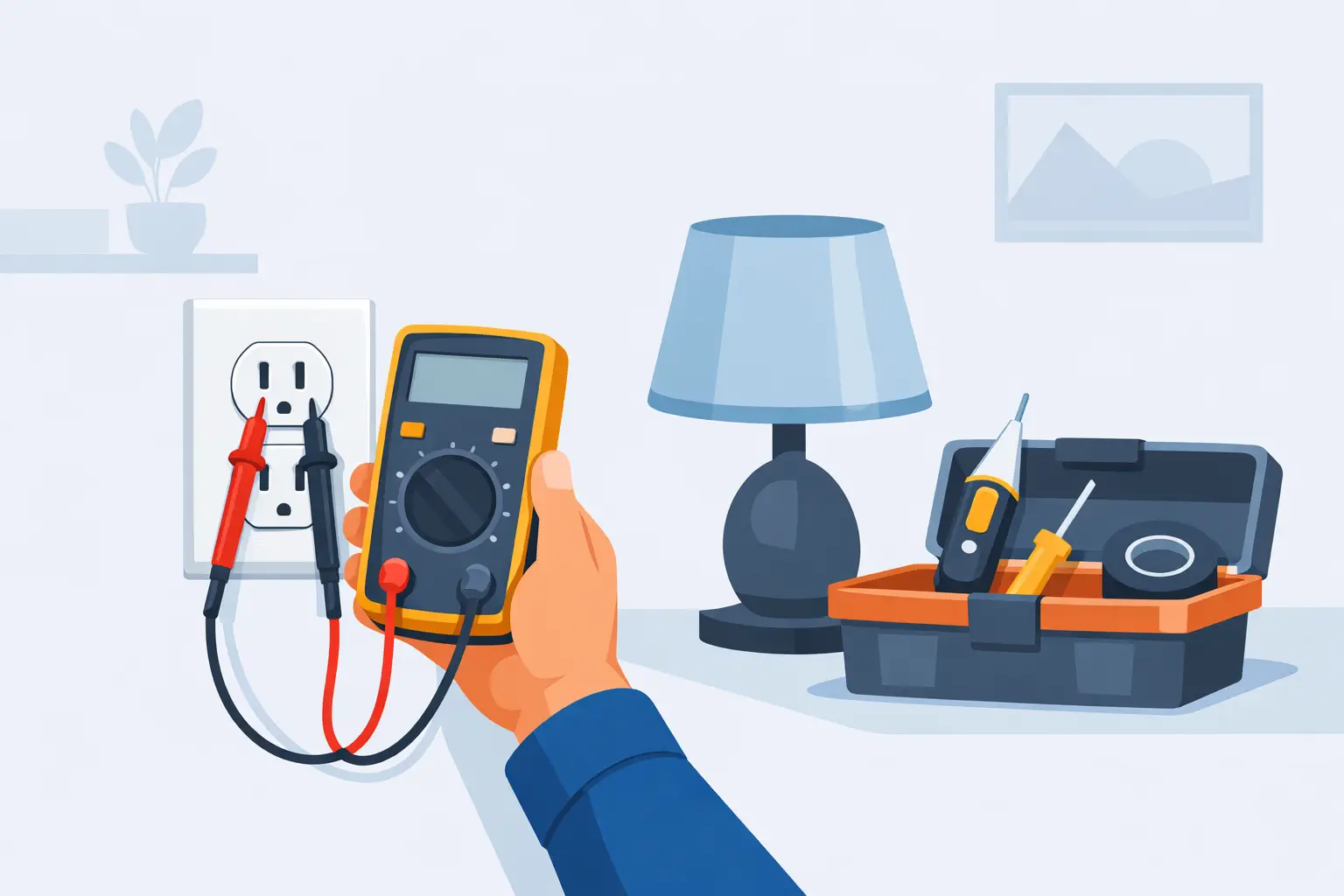
If you have basic electrical experience and a digital multimeter, you can check whether voltage is present at the receptacle. Set the meter to AC voltage. On a standard 120-volt outlet, place one probe in the narrow slot and the other in the wide slot. A healthy energized outlet should read around 120 volts.
If you get no reading, test from the narrow slot to the ground opening. Then test from the wide slot to ground. These readings can help narrow down whether the issue is a lost hot, a lost neutral, or another wiring fault.
This is where interpretation starts to matter. No reading at all may mean the outlet truly has no incoming power. A reading from hot to ground but not hot to neutral can point to an open neutral. Those are useful clues, but they are also signs that the problem may be beyond a simple reset.
If you are not fully confident using a meter around live voltage, skip this step. There is no benefit in turning a minor outlet issue into a safety hazard.
When the outlet itself may be the problem
Sometimes the receptacle has simply failed. This is more likely in older homes, outlets that see heavy daily use, or locations where plugs are frequently inserted and removed. Signs include loose plug fit, discoloration, cracking, warmth, or intermittent power before the outlet went fully dead.
A failed outlet can also be a symptom rather than the root cause. In some cases, the wire connection behind the outlet loosens over time, especially if push-in backstab connections were used instead of more secure terminal screw connections. That loose connection may kill power to one outlet or several farther down the line.
This is one of those situations where it depends on what you find. Replacing a worn receptacle may solve the problem if the wiring is otherwise sound. But if there is heat damage, melted insulation, or signs of arcing, the repair should go beyond swapping the device.
Signs of a larger electrical issue
A dead outlet is not always an isolated repair. If you notice flickering lights, breakers that trip often, buzzing sounds, warm cover plates, or multiple problem outlets in different rooms, the issue may involve the circuit, the panel, or the overall condition of the home’s wiring.
That is especially true in aging homes where previous additions, DIY repairs, or outdated electrical components can create hidden weak points. In those cases, the dead outlet is often the symptom that finally gets noticed.
For homeowners in older neighborhoods around Palmdale and Lancaster, this comes up regularly. What starts as one nonworking outlet sometimes leads to a needed circuit repair, GFCI update, or panel-related correction that improves safety and long-term reliability.
When to call a licensed electrician
You should stop troubleshooting and call a professional if the breaker keeps tripping, the GFCI will not reset, the outlet shows burn marks, you smell something hot, or your testing suggests a wiring fault. The same goes for aluminum wiring, older ungrounded outlets, or any uncertainty about what you are seeing.
There is a practical reason for this. Electrical problems are not just about restoring power. They are about making sure the failure did not happen for a dangerous reason. A trusted electrical repair should solve the outage and protect the home from the next problem.
A licensed residential electrician can test the circuit, inspect the outlet and upstream connections, verify breaker performance, and identify whether the issue is localized or part of a wider concern. That kind of diagnosis saves time and helps avoid repeat failures.
A careful approach protects your home
Knowing how to test dead outlet problems gives you a useful starting point. Check the device, the switch, the breaker, and any nearby GFCI first. Use simple tools if you are comfortable with them, and pay attention to whether the issue seems isolated or connected to a larger pattern.
When the signs point beyond a quick fix, it is worth choosing quality and safety over guesswork. A dead outlet may be minor, but treating it carefully is one of the simplest ways to protect comfort, reliability, and peace of mind at home.